
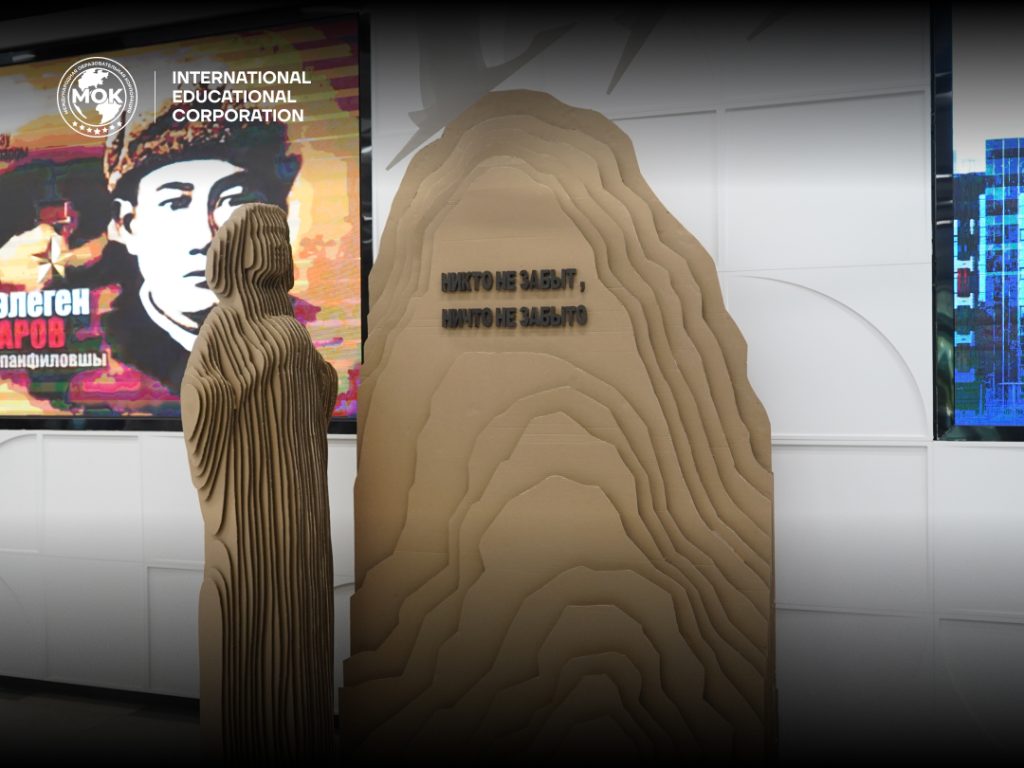
On May 8, 2026, the International Educational Corporation (KazGASA) held the official opening of the artistic memorial installation “Cranes,” dedicated to Victory Day and honoring the heroes of the Great Patriotic War.
The project was implemented by faculty members and students of the School of Design and became the result of collaborative creative and research work. The authors include faculty members R.Kh. Kabilova and A.N. Lobanova, together with students who combined an architectural approach, artistic interpretation, and in-depth exploration of the historical theme.
The concept of the installation is based on the “Cranes” memorial complex dedicated to the Gazdanov family, whose seven sons died during the Great Patriotic War. This image symbolizes not only personal tragedy but also the fate of millions of families who sacrificed their loved ones for peace and the future.
The installation is done in the aesthetics of parametric design, one of the contemporary approaches in architecture and spatial design. Through digital modeling and algorithmic form generation, the authors created a dynamic composition conveying a sense of movement, flight, and lightness. The image of flying cranes symbolizes memory, spiritual continuity, and the connection between generations.
During the opening ceremony, representatives of the university and the project authors delivered speeches, emphasizing the importance of such initiatives in fostering civic values among young people. Special attention was given to the educational aspect of the project: students were involved in all stages, from studying historical materials and developing the concept to digital modeling, prototyping, and installation.
For the students, this project became a unique practical experience, allowing them to apply their professional skills in real conditions and to understand the role of design in preserving historical memory.
The “Cranes” installation is not only an expressive artistic object but also a meaningful cultural and educational statement addressed to the younger generation. The project demonstrates the potential of integrating architecture, design, and art in shaping values, respect for history, and awareness of the importance of peace.