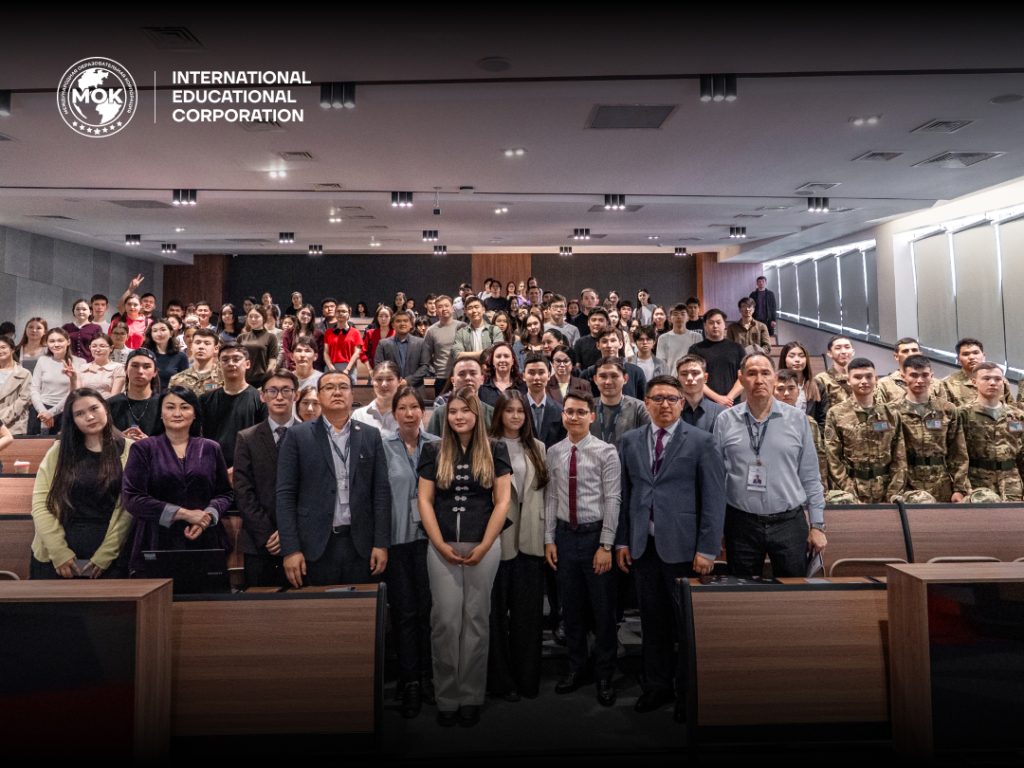
From April 1 to 10, 2026, the International Educational Corporation (KazGASA) held the annual Science Decade, traditionally organized in honor of the Day of Science Workers. This year, the event also coincided with the 45th anniversary of the academy. The Science Decade brought together students, faculty members, researchers, and representatives of the academic community around актуal scientific, educational, and applied initiatives. The program covered a wide range of fields, including architecture, construction, design, engineering disciplines, digital technologies, and sustainable development, demonstrating an interdisciplinary approach to shaping the modern scientific agenda.
The opening of the Science Decade featured a welcoming speech by the Rector of IEC (KazGASA), Bakhtiyar Sabdenaliyev, who emphasized the importance of developing the scientific environment and integrating research into the educational process. A large-scale exhibition of scientific and research projects presented by all schools of the academy was organized in the main academic building. The exhibition showcased the results of students’ and faculty members’ research activities, including applied developments, architectural and design concepts, and engineering solutions in construction.
As part of the first day, an open day of IEC (KazGASA) laboratories was held, allowing participants to ознакомиться with the academy’s modern research infrastructure. A key event was an expert roundtable discussion titled “Almaty in the Context of Sustainable Development: Environmental, Infrastructure, and Socio-Economic Challenges,” where participants presented analytical insights and proposals for the development of the urban environment.
In the following days, the Science Decade program continued with a series of scientific, educational, and practice-oriented events. A student workshop, Structural Stability Challenge, was held, aimed at developing engineering thinking and skills in analyzing structural solutions. In addition, a specialized master class on preparing scientific publications was organized for faculty members, young researchers, master’s and doctoral students – covering everything from structuring an article to selecting relevant academic journals. The event was aimed at developing research competencies, improving the quality of scientific work, and engaging young researchers in the international academic community.
It is worth noting that in the first days of the Science Decade, the events were attended by leading national and international experts, which ensured a high level of discussion and enhanced the practical relevance of the presented content.
The program continued with a master class titled “Modern Architecture: Opportunities Without Limits” and a panel discussion “Youth and Science: From First Research to Professional Development.” These sessions addressed issues related to student engagement in scientific activities, career pathways, and the development of research competencies.
On April 6–7, as part of the Science Decade, the XXVI Republican Student Scientific Conference was held, bringing together young researchers from various regions of the country. At the same time, the KazGASA Research Vision poster competition took place, showcasing the best student research projects. During these days, the Science4Energy Hack hackathon was also organized, aimed at developing innovative solutions in the fields of energy and sustainable development.
On April 8, the Republican subject Olympiad was held, with participation from more than 20 universities across Kazakhstan and over 350 students from different regions of the country. On April 9, a ceremonial awarding of the Olympiad winners took place. On the same day, the second stage of the Republican competition of student research works (SRWS) was held, along with a poster competition that demonstrated the high level of participants’ preparation.
Special attention in the program was given to presentations by invited experts. At the School of Architecture, a lecture was delivered by architect and lecturer of Caspian University, Artur Shadyarov, on the topic “The Use of AI in Architecture and Design.” The lecture presented modern design approaches using neural networks and digital tools. Considerable interest was also drawn to the master class by architect Bahrom Usmanov titled “Architecture of the Future and the Space of Happiness,” which covered real case studies of major projects implemented in Kazakhstan and Central Asia, as well as the integration of architectural thinking, engineering solutions, and project management.
The final stage of the Science Decade included student poster presentations dedicated to актуal social and scientific issues. In addition, a master class on the commercialization of scientific developments and the implementation of research results was held, focusing on the practical application of scientific ideas.
On April 17, the official closing ceremony of the Science Decade took place. During the event, the results of all activities were summarized, and participants who made a significant contribution to the organization and active participation in the scientific program were recognized. The best students, faculty members, and organizers were awarded for their high level of engagement and contribution to the development of the academy’s scientific environment.
The Science Decade became an important milestone in the development of the scientific and educational ecosystem of IEC (KazGASA). The initiative is aimed at integrating science, education, and industry, as well as forming a new generation of specialists capable of working in the context of technological and economic transformations.